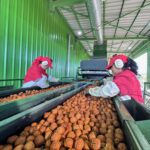



The Los Lagos Region is projected to export 860 metric tons of European hazelnuts in 2026, while the city of Osorno has inaugurated a new regional processing plant— a milestone that strengthens value chain integration and reinforces the crop’s growth across southern Chile.
OSORNO, Chile. — Chile’s European hazelnut industry continues to expand across the country’s southern regions. Over the past week, the Los Lagos Region officially launched the 2026 export season while Osorno inaugurated a new European hazelnut processing facility, regarded as one of the most advanced of its kind in the region.
Chile’s Agricultural and Livestock Service (SAG) has begun phytosanitary inspections and certification of shipments destined for international markets. In 2025, the agency certified exports totaling 759,617 kilograms of European hazelnuts, mainly to Germany, Italy, Spain, and Argentina. For the current season, exports are projected to increase to 860,000 kilograms, equivalent to 43 containers, with the potential to open additional export markets during the year.
The figures reflect the sustained growth of a crop that has found highly favorable conditions in southern Chile. The Los Lagos Region currently has approximately 1,433 hectares planted with European hazelnuts, concentrated mainly in the municipalities of Osorno, San Pablo, Puyehue, and Río Negro.
Complementing this production growth is the inauguration of a new processing plant developed by Nefuen and Grupo Hijuelas in Osorno. The facility incorporates state-of-the-art technology for processing shelled hazelnuts, the format that accounts for much of international demand. The project will add value to local production, improve operational efficiency, and reduce processing costs.
The companies behind the investment emphasized that the new infrastructure will help further integrate the production chain by bringing processing and commercialization stages—previously carried out outside the region—closer to the production area. After more than a decade of development and innovation, the plant represents an important step toward enhancing the competitiveness of Chile’s hazelnut industry against the world’s leading producers.
The expansion of European hazelnut production comes at a particularly favorable time for Chile. The country has consolidated its position as the world’s second-largest producer of European hazelnuts and continues to expand planted acreage, driven by growing demand from the global chocolate, snack, edible oil, and food processing industries.
With increasing export volumes and new processing capacity at origin, the Osorno Province is strengthening its role as one of Chile’s most dynamic hubs for European hazelnut production, further reinforcing the crop’s growing importance within the country’s fruit industry.