


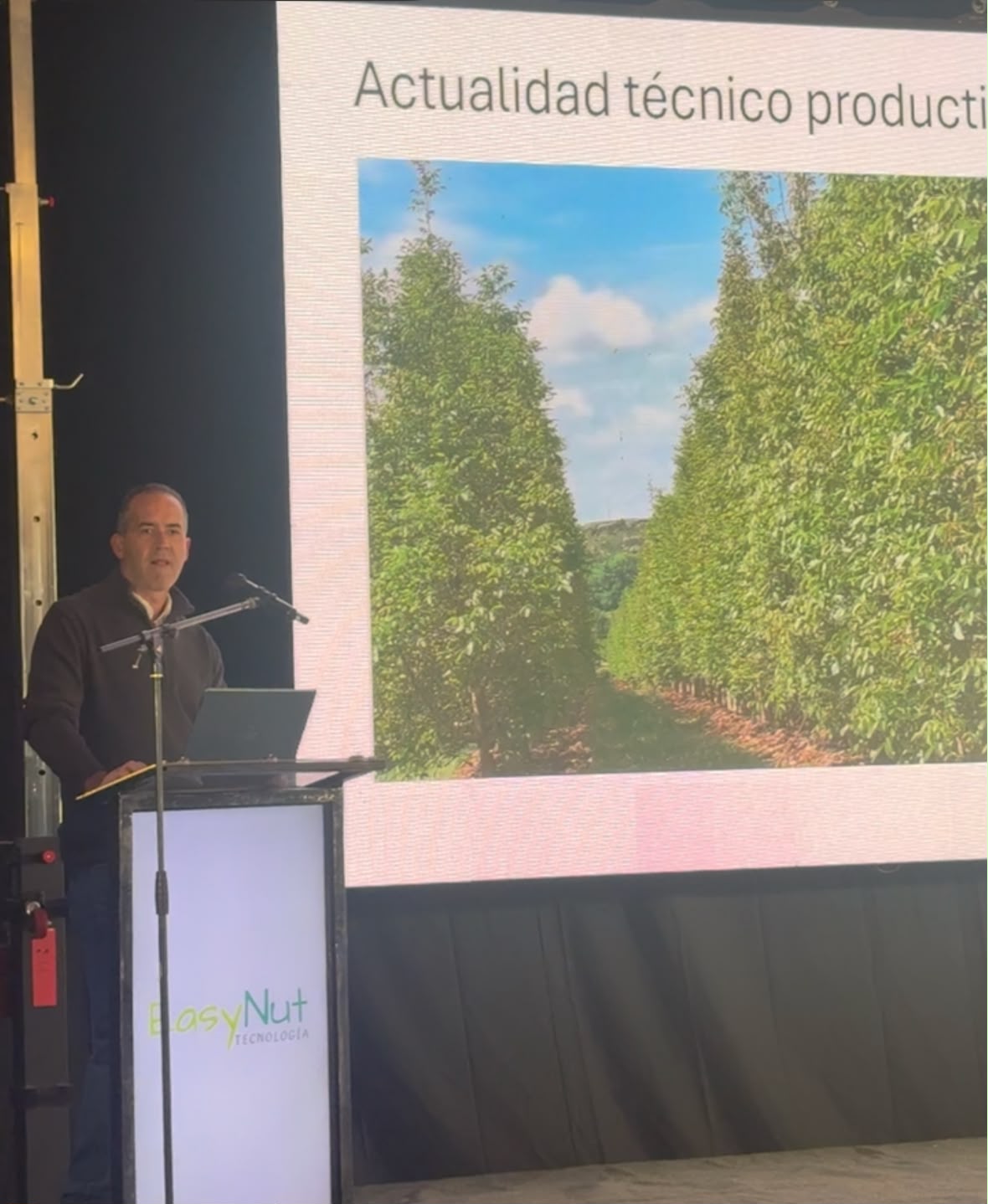
CURICÓ, Chile. Amid growing water scarcity and the need to diversify Chile’s fruit production matrix, pistachios are beginning to emerge as a viable alternative for a significant portion of the country’s agricultural sector. This was the message delivered by Miguel Carús, technical advisor at EasyNut Tecnología, during his presentation at Nuts Technical Day 2026 in Curicó.
Globally, the crop is experiencing a period of rapid expansion. World production has more than doubled over the past decade and is projected to reach approximately 1.18 million metric tons in the 2025/26 season, driven primarily by the United States and Turkey. However, the industry’s leading producers are facing increasing challenges.
California, the world leader with nearly 250,000 hectares planted and about 65% of global production, has seen the expansion of new orchards slow due to restrictions imposed by the Sustainable Groundwater Management Act (SGMA). Meanwhile, Iran continues to lose relevance as a result of freshwater shortages and trade limitations, while Turkey faces pronounced alternate bearing cycles as well as recurring drought and frost events.
Against this backdrop, Chile is emerging as a strategic opportunity. As a Southern Hemisphere producer, it could supply European and Asian markets with fresh pistachios between March and September, reducing reliance on extended storage periods. In addition, pistachios have historically shown lower price volatility than many other tree nuts, typically trading within a range of USD 6–8 per kilogram.
At present, Chile’s planted area does not exceed 200 hectares and is concentrated mainly in the Metropolitan Region. Most orchards consist of experimental plantings and small-scale projects, while the domestic market continues to rely heavily on imports, primarily from the United States.
One of the main barriers to industry development has been the slow production onset of traditional orchards. Historically used varieties in Chile, such as Kerman and Peter, may require eight to nine years to reach commercially significant yields and are characterized by high chilling requirements and pronounced alternate bearing.
However, genetic advancements are changing this outlook. New California varieties such as Golden Hills and Lost Hills, combined with the UCB-1 rootstock, can reduce the non-productive period to four or five years, achieve potential yields exceeding 5 metric tons per hectare, and improve nut quality. Likewise, varieties such as Sirora, developed in Australia, have demonstrated better adaptation to areas with lower chilling requirements—an especially relevant characteristic for several productive regions of Chile.
Carús emphasized that success will depend on the proper selection of growing areas and varieties. Pistachios require winters with at least 600 chilling hours, more than 2,000 growing degree days during the season, low relative humidity, and deep, well-drained soils. Although the species is considered hardy and relatively efficient in water use, it demands increasingly specialized management to achieve high levels of productivity and quality.
Another significant advantage is its high degree of mechanization. Harvesting can be carried out using systems similar to those employed in California, substantially reducing dependence on seasonal labor and creating synergies with walnut and other tree nut producers that already possess mechanized harvesting infrastructure and expertise.
According to Carús, the challenge is no longer simply planting more hectares. Building a competitive industry will require greater availability of certified nursery stock, expanded local research, the identification of optimal production zones, and the development of processing and marketing capabilities geared toward export markets.
“Chile has the conditions to produce high-quality pistachios,” Carús concluded. “The opportunity is there, but it will be necessary to build the technical and commercial foundations that can transform pistachios from an experimental crop into a true industry.”